The sunflower
It bows down to the Sun
The image of resilience.

Saturday, September 9, 2023

Debating Renewables: the Clash of the Straw Men


(image Created by Dall-E)

There has to be some reason why we tend to polarize every issue and divide ourselves into two opposite fields engaged in a struggle of strawmen. And yet, we keep praising the "open debate" even though we know that it doesn't work, it never worked, and perhaps never will. 

Try it with renewable energy. You state that renewables are a good technology to produce energy, and you are immediately submerged by a tsunami of criticism from angry people who accuse you of wanting to destroy the planet and starve people to death in the impossible attempt to keep the economy growing. On the other side of the debate, some people really think that "sustainable development" is really nothing different from the good, old economic growth, except that it is painted in green.

Is it possible to strike a middle way? Marco Raugei, a scientist working on renewable energy, puts forward a plea for understanding each other in a recent paper published on "Biophysical Economics." With the prudence typical of the scientist, Raugei starts with, "There appears to be a growing polarization." My gosh! Marco, did you really say "there appears to be"???  But the paper makes a very simple point, unfortunately almost always obscured in the clash of the titanic strawmen. It is that it is perfectly possible to use renewable energy to replace fossil fuels, but the resulting world will not be the same as it is today. And this possibility doesn't free us from the constraints that a finite world poses on economic growth. So simple, and so impossible to understand!

Let me propose to you a few excerpts from Raugei's paper:  

___________________________________________

From: 
By Marco Raugei, Biophysical economics, 8, Article number: 4 (2023)

...several academic authors have increasingly positioned themselves (either explicitly or implicitly, but often equally unmistakably) within either of two seemingly ideological “camps.” These may be broadly characterized as, respectively, that of the “systemic pessimists” (i.e., authors who champion concepts such as carrying capacity, overpopulation, overshoot, peak oil, and peak resources, but who often downplay or even dismiss the potential of renewable energies) and that of the “technological optimists” (i.e., authors who mostly tend to focus on the rapid advancements in renewable energy technologies and the promise that these hold to decarbonize future societies, while often failing to address the broader context of other bio-physical planetary limits). While proponents of both camps often bring valid arguments and evidence to the table to support their viewpoints, they often seem to summarily dismiss the arguments and evidence put forth by the other camp, thereby ultimately allowing the discourse to degenerate into an unhelpful and, arguably, un-scientific “us vs. them” contest.

In the 1970s, the Club of Rome (a group of current and former politicians, United Nations administrators, diplomats, scientists, economists, and business leaders from around the globe) commissioned the famous report “The limits to growth” (Meadows et al. 1972), in which the consequences of unconstrained population and economic growth were quantitatively investigated by means of a computer model based on five key interdependent variables: population, agricultural production, non-renewable resource depletion, industrial output, and pollution generation. Widespread and long-lasting debate and controversy ensued on many details about the model structure, parameters, and assumptions, but the key message was clear, and it was essentially found to still hold by several other authors who reviewed and updated the calculations (Bardi 2011; Herrington 2020; Hall 2022): the Earth’s system is incapable of supporting infinite population and economic growth because of the finite nature of its natural resources.

More recently, a range of authors have taken it upon themselves to reaffirm these fundamental concepts within the specific context of future energy scenarios. But a new dimension to the discussion had been added in the interim, as various independent studies, often based on life cycle assessments (LCA), had started to appear, pointing to high energy return on investment (EROI) of renewable energies, and specifically photovoltaics (PVs). By some, these results were interpreted as undermining the very foundations of the concepts discussed above, for if renewable energy were indefinitely viable then perhaps the “limits to growth” could be postponed indefinitely. As a result, what was originally a discussion about finite resources in a more general sense, started turning into much more specific arguments about issues like what is the proper EROI for PVs and/or other renewables; broadly speaking, the debate on the ultimate possibilities of renewable energies became unhelpfully conflated with whether or not there are limits to growth.

In fact, some of these authors (e.g., Seibert and Reese 2021) have tended to paint renewable energies as a pernicious distraction from the key issue of global overshoot of the Earth’s carrying capacity, therefore also brushing aside any suggestion of renewable energies’ ability to significantly reduce global warming and environmental degradation (vs. the continued use of fossil fuels). ... “technological optimistic” authors may have studiously and rigorously investigated the potential of renewable energies to deliver modern societies from the grip of fossil fuels, but they have failed to consider the wider issues that would continue to affect the world, even in a future world largely supported by renewable energies. In fact, the hitherto dominating paradigm of unfettered growth in material consumption and rampant exploitation of many natural and ecosystem resources is incompatible with fundamental bio-physical constraints (Rockström et al. 2009; Steffen et al. 2015), and it remains ultimately unsustainable irrespective of which energy resources are used to power it.

...the current polarization of views points to a false dichotomy that risks devaluing both positions, and it trivializes what should instead be the most important research questions of all, namely: to which extent a more sustainable future is indeed possible, and which systemic changes (including, but not limited to, phasing out fossil fuels) will be required to achieve it. ... Ultimately, it is high time to admit that both sets of core arguments loosely ascribed in this article to the two opposed ideological “camps” are probably simultaneously true, to some extent at least. And from this simple realization follows what should have been obvious all along, i.e., that adopting a more balanced “middle way” approach is the only truly sensible way forward for a healthy and genuinely scientific debate. 


The complete paper by Marco Raugei is available at this link

Sunday, September 3, 2023

The Latest Data about Oil Production: Those Pesky Naked Apes are not Giving up their Addiction to Fossil Fuels.


The updated peak oil model proposed by Ron Patterson in his blog. The data are in million barrels (Mb) per day. Production stubbornly refuses to decline, and we may have a few years more before it finally peaks and starts going down.


Fossil fuels stubbornly refuse to die. The latest data reported in the excellent site "Peak Oil Barrel" summarizes the situation as it is now. The world oil production of "crude + condensate" (C+C) has nearly returned to the pre-COVID levels, may surpass them in 2025, and keep growing until 2028. Note that this is "conventional" oil; if we include "all liquids," and in particular tight oil, the amounts produced increase, but the peak date doesn't change much.

These data show that the global production of liquid fuels may stay for a few more years at levels near 100 Mb/day. Not only may oil production remain at the highest levels ever seen in history, but the same is true for the other two main fossil fuels: coal and natural gas (you can see some recent data in Gail Tverberg's blog). 

At the beginning of the current century, it was believed that geological and economic constraints would lead to reaching the maximum oil production ("peak oil") before the end of the 2nd decade of the century. But those estimates didn't consider how desperate the need for liquid fuel was. The result was an ace up the sleeve called "tight oil" or "shale oil." It was unexpected: most experts thought that shale oil was too expensive to have a role in the market. It didn't matter: shale oil production was financed and supported even though it required enormous investments in terms of resources. As a result, oil prices rose to levels considered unthinkable a few decades before, incidentally beggaring a large number of people. Among other things, shale oil allowed the United States to keep playing the Emperor of the Hill

How about the future? What we see in Patterson's graphs are model-based extrapolations with all the uncertainties involved. In particular, the model considers a symmetric production curve, with the decline mirroring growth. But that's not necessarily true. Any global shock, such as another pandemic, a major financial crash, or a large war, could cause production to plummet rapidly, giving the curve the "Seneca Shape" -- that is, with the decline much faster than growth. 

On the other hand, we cannot exclude another parting shot by the fossil industry. After seeing what they could do with tight oil, we cannot dismiss the possibility of a move to synthetic fuels manufactured from coal. The technology is known; coal is still relatively abundant, so it could be done. That would be a true Derringer up the sleeve, leading to several more years of production of liquid fuels at the current level. 

We have to face reality: the naked apes of planet Earth are not going to give up their addiction to crude oil. Not so soon, anyway. Dire climate scenarios, international treaties, or individual goodwill do not seem to affect the attempt to keep producing fossil fuels as much as possible, as fast as possible, up to the last drop of oil or the last lump of coal. Indeed, governments are specializing in a form of doublespeak that they use to proclaim that they care about reducing carbon emissions while at the same time encouraging the fossil industry to produce more ("green coal," anyone?)

So, what's going to happen? One possible scenario is that we simply keep going along the curves of Patterson's models. In this case, we have at least a few more years left to keep the world's economic system alive, even though ordinary people will all be progressively poorer because of the increasing energy costs to produce energy (declining EROI). Nevertheless, that could result in a certain degree of stability that would allow the deployment of a significantly large renewable infrastructure. In some 30 years projections indicate that it would be possible to sustain the global economy (or a smaller version of it) wholly on renewable energy. Would that be fast enough to save us from the collapse of the ecosystem? Probably not, since the collapse is already ongoing. In the case of a rush to synfuels, then, an ecosystemic collapse would be surely unavoidable. Besides involving a disastrous increase in carbon emissions, synfuels would subtract precious resources from the task of building a renewable infrastructure. In this case, the Derringer up the sleeve would be used to shoot oneself. 

Another scenario involves the deployment of geoengineering on a massive scale to avoid the most damaging consequences of global warming on the economy. The uncertainties are enormous, but, if it were to work, it would give humankind some time to apply the "Sower's Strategy," allocating a sufficient fraction of the remaining fossil energy to the move to renewables.

There are other possible scenarios: one is the "transition to panic," according to Schlesinger's principle ("humans have only two modes of operation: complacency and panic"). Panic could be generated by growing evidence of the ongoing climate catastrophe. That might finally lead to a serious effort to curb the use of fossil fuels or, more likely, to more sophisticated doublespeak about green coal. Conversely, panic about a collapsing economy could lead to a backlash against renewable energy, accused of being the culprit of whatever disaster befalls humankind. After reading comments of people seriously claiming that induction stoves have been purposefully designed to starve them to death, anything can happen. And that, obviously, would lead humankind straight into a climate catastrophe.

As usual, the future is uncertain and always surprising. The only certain thing is that we are going to see enormous changes, and those changes may be bad, but they are also opportunities. The "Seneca Cliff" always involves a "Seneca Rebound" that may allow us to shape human society in a way that does not fight the ecosystem but adapts to it: the "Sunflower Paradigm.


Monday, August 28, 2023

Energy too Cheap to Meter. A Comment by Christian Breyer on the Future of Renewables


A picture I took a few days ago of the sun setting behind the chimney of a house in central Tuscany. The sun is the ultimate source of energy for us, and it comes for free! Too cheap to meter.


Last year, I published a post on "The Sunflower Paradigm" blog where I discussed the sun as a "nuclear plant in space," the embodiment of the old concept of "energy too cheap to meter" that was expressed during the euphoria of the nuclear age, in the 1950s.

The low cost of the current generation of solar and wind energy makes it possible to return to that old concept. We don't need to bother with complex, expensive, and dangerous nuclear reactors on the Earth surface. We can use a nuclear fusion plant located in space; the sun. It works, it is already there, it costs nothing, and we now have good technologies to convert the energy it creates into electricity. It is cheap energy. Not yet "too cheap to meter" but moving in that direction. Look at these impressive data:


Unfortunately, many people (including opinion leaders and decision-makers) seem to have entered a negative psychological loop that pushes them to deny the usefulness of renewable energy and wait instead for impossible miracles, well knowing that they will not arrive. It is discussed, among others, by Glenn Albrecht in his book "Earth Emotions, " where he says

" When life becomes intolerable and there seems to be no way out, prayers and desperate hope for a final end, so that we might start all over, beckon. The nonbelievers in "rapture" religion simply engage in disaster euphoria, take drugs, and drink more."

So, I thought that the readers of this blog may be interested in the comment on the concept that I proposed that I received from Christian Breyer about this Christian is Professor for Solar Economy at LUT University, Finland. one of the foremost researchers in the field. is his comment, published with his kind permission and with a few minor edits to improve clarity. 

_________________________________________________________________________

Christian Breyer wrote:


Ugo, first of all, many thanks for your initiative.

Personally, I do not like much the wording ‘fusion power’ since it has a legacy of decades-old promises without any relevance for reality due to ongoing failures – why solar energy should be downgraded by such a bad reputation? That may be only my personal thoughts, since ‘fusion power’ (on earth) is nice wishful thinking, and, in the end, great research for high-temperature physics at its edges and respective material science, but has no relevance for energy supply. In case it might be successful, then it would be available at a time when the (solar & wind) powered global energy system has helped to survive the climate emergency. In any case, with all cost estimates as of today for a non-existing technology, it seems to be not competitive at all, since a 100% renewable energy system based largely on solar and wind will cost the same or less, but with a technology that can be handled by all countries globally, in particularly in the Global South, where most the additional energy demand will arise.

As a physicist, I fully agree that you are right 😉 and the fusion power of our sun is the way forward (among some other solutions). There may be another less helpful misunderstanding: solar power plants in space for sending energy on earth (space solar power). This option is nicely discussed from time to time, but chances are high that it will be never introduced at large, finally due to costs (higher than on earth) and the risk (destroyed due to all the garbage in the orbit and attacks due to warfare – we learn right now that nuclear threat in warfare is no theory but brutal reality).

We are now in year 47 of 100% renewable energy systems research. The following is really important:

Base load demand: will exist as long as a civilization is using electricity

Base generation demand: is something of the past of a fossil-nuclear energy system which is NOT required in an energy system based on solar and wind energy and modern technology options utilizing flexibility which is available in large quantities, and, NOT compromising energy services at all (for instance shown here: https://www.sciencedirect.com/science/article/pii/S0360544221007167; in more conceptual detail here: https://www.sciencedirect.com/science/article/pii/S0306261920316639, or here: https://www.sciencedirect.com/science/article/pii/S036054421831288X).

Modern energy system analyses are done in hourly resolution with real weather data and real demand data, so that it can be easily checked how a system has to be designed in such a way that it works properly at all hours of the year.

For those who still think that base generation would be impossible (or required) – we have even prepared a scientific paper in which this is shown on the based on solar and wind power (https://doi.org/10.1016/j.jclepro.2019.118466). The PhD student couldn't understand why such a ‘nonsense’ as base generation should be even published, since in state-of-the-art scientific publications, it has been shown in hundreds of papers that it is not required. However, for the debates on the topic, it helps to show that it will not be required, but even that could be done (BTW, for substantially less cost than new nuclear power …).

This is also discussed and embedded in a topical review on 100% renewable energy systems research as recently published (a bit more below): https://ieeexplore.ieee.org/document/9837910

RethinkX: Be aware that the oversimplified approach of Seba et al. is dangerous and makes only sense for those who have little clue about a real energy system. Why? An energy system based on solar-wind-batteries (and nothing more) is NOT stable and will NOT work for an uninterrupted electricity supply. I strongly suggest getting the RethinkX ideas published in a scientific journal, so that all the limitations of the oversimplification are made transparent.

The literature review on EROI in the linked Earth4All document is very good and worth reading. The fundamental impact of the learning rates is well presented, BUT a real energy system is MUCH more complex than the oversimplification indicates.

A more realistic approach is close, as around 90% of all electricity could be from solar and wind power, and about 95% of all storage could come from batteries, as shown in this paper (https://www.nature.com/articles/s41467-019-08855-1), BUT, the lacking discussion on the difference to 100% is the reason why skeptics may believe that a solar and wind-powered system would not work (… “in hours of lack of sun and wind” …). A variety of smaller solutions enable the low-cost and stable 100% renewable solution. The much-discussed sector coupling (also called smart energy system) comes on top and further reduces the energy system cost. Again, more food for thought and references in the above-linked topical review article.

Outlook:

I do not want to be pessimistic, there is much indication to welcome a bright future.

In a recent review article, researchers from 15 universities (several are here on this list) have summarized the state-of-the-art of 100% renewable energy systems research:

https://ieeexplore.ieee.org/document/9837910

(overview on the roots of the discipline, development of publications, relevant global studies, regular criticism and the response [EROI, materials, variability, costs, a.o.] and a research outlook) – 400+ references are provided for further reading, and the knowledge of several key researchers in the field is aggregated, also representing the 5 teams with the most published articles in the field – while the emphasis was high to be as inclusive and balanced as possible when it comes to technologies, approaches, discourses and specific topics of relevance.

We have all in our hands to create a truly sustainable civilization, as for the first time humans have the technology and means to enable a world of energy wealth for all humans by the end of this century. This even implies the reduction of CO2 in the atmosphere, as it would be energetically affordable, and sustainably doable (although not with BECCS). There seems to be no fundamental show-stopper as long as (sustainable) renewable resources are used and a circular economy is the basis of our activities.

Best regards,

Christian


Saturday, August 19, 2023

Desperate Measures: Geoengineering as Humankind's Last Climate Gamble


Those who can read the writing on the charred walls of Lahaina's houses are starting to understand that the climate situation has taken a turn for the worse. Nevertheless, the public reaction has been mainly that of the guy with the red tie on the left of Tol's illustration. We could call it "Tol's paradox:" People hate the things that are good for them. And yet, that kind of reaction is dominating the debate on social media and in right-wing political circles. Given the situation, it is possible that the Powers that Be will switch to a new plan of action. "Plan C," based on geoengineering, may be coming.


During the past decades, the idea of acting to counteract the damage done to the ecosystem by humankind's activities has moved along at least two planning stages. 

"Plan A": Global agreements. Already in 1972, "The Limits to Growth" study proposed a possible procedure. It consisted of finding global governmental agreements to implement actions to reduce emissions. The imprint of these early ideas was visible in the COPs (conferences of the parties), which started in 1995 in Berlin. But, after almost thirty years, we see that this approach just can't work. Governments tend to act according to the instructions of their sponsors, typically industrial lobbies who have no intention of allowing their representatives to sign their death sentence on their behalf. And that's exactly what the attempt at zeroing emissions is: a direct attack on the fossil fuel lobby. Consider that the oil&gas industry has a budget in the range of several trillion dollars, about 3%-5% of the world's GDP. No lobby is powerful enough to overcome them easily. Even bombing them into submission would be impossible because the engines of bombers run on fossil fuels. Nothing can be done without the approval, or at least the neutrality of the fossil fuel industry. As you would expect, they fought back with a strategy of delaying, minimizing, and occasionally demonizing their opponents. So far, they have been successful. There is no evidence that the various treaties negotiated at the COPs significantly affected emissions; at most, they generated widespread greenwashing that hurt nobody but did nothing useful.

"Plan B" The Transition. The idea took shape in recent times when the dramatic reduction of the cost of renewable energy led to the idea that phasing out fossil fuels was not a dream for hippies but a real possibility. The incredibly fast growth of renewable energy production over the past few years gave substance to this idea. So, the plan was (and still is) that we don't need to worry too much about what people think about climate change. They may believe it is a hoax, but they'll welcome low-cost energy, clean air, pure water, etc. So, we eliminate fossil fuels, and all will be well in the best of worlds. 

We now realize that even though Plan B is perfectly possible, it has fundamental problems. The first is the same as that of global treaties: replacing fossil fuels means destroying the fossil fuel industry, and you can't expect them to take it meekly, to say the least. They seem to be taking the threat seriously and one of the countermeasures is a PR campaign against everything that can be defined as "green." 

The success of the denigration campaign is based in large part on how the public lost trust in science after the mismanagement of the Covid crisis. The result is a whole ecosystem of memetic maggots festering on the corpse of what once was the credibility of the meme called "science." It also gave life and substance to "Tol's Paradox" as expressed in the image at the beginning of this post. If you follow the debate on social media, you'll see the widespread white-hot rage against everything that can be seen as "green." Proposals that seemed to be wholly innocent up to a few years ago, from home insulation to induction stoves, are now seen as devilish tricks designed to enslave or kill us.

The most optimistic scenarios show that renewables could bring emissions to zero by 2040-2050, but only for a concerted global agreement to dedicate large amounts of resources to the transition. Given the strong backlash against renewables and green things in general, it is unlikely that such an agreement can be obtained in the near future. On the contrary, it is perfectly possible that some governments will actively work to slow down or even reverse the penetration of renewable energy in the world's energy mix. We are already seeing that happening, for instance in Texas. Even if it were possible to phase out fossils by -- say -- 2040, that may still be too late to save the ecosphere as we know it.

Plan C. Geoengineering. It is a growing idea that's gaining space in the memesphere, even though it is still looked at with great suspicion, often considered tantamount to a sacrilege against the Goddess Gaia in person. Yet, we can't forget that humans have been engineering the ecosystem from when they learned how to make fire; a few hundred thousand years ago. So we are not doing anything different from what we have been doing, except that geoengineering is a last climate gamble because there are many ways in which it could fail, for instance, by arriving too late or by causing more damage than benefits. But it has an enormous advantage: it does not go against the interests of the fossil fuel lobby. They may actually embrace the idea or, at least, keep a neutral stance.

In addition, it may be possible to act on climate by technologies such as solar radiation management (SRM) for costs that may be inferior to 100 bn$ (See Sovacool 2021) (2). This is a cost smaller than that of the war in Ukraine. Hi-tech lobbies, such as the aerospace industry, may be able to obtain this kind of financial support from the government. 

This "Plan C" has several advantages over the previous plans. One is that it doesn't have to be international. It is akin to starting a war; you need only one side to decide that it should start. In the same way, a single country could start a global SRM plan. Imagine that China, alone, were to decide to place mirrors in space to reduce solar irradiation. Hard to imagine that anyone could stop them. The same is true for the US or even for just California. Even Elon Musk or Bill Gates, alone, could engage in such a plan.  

Finally, note that Plan C has the same advantage as Plan B in that there is no need to convince people that climate change exists and is a bad thing. It could even be implemented without telling anything to anyone except the highest government levels. Suppose the sun's luminosity decreases by about 1%-2% (it is all that's needed). Could you detect it? No. So, what proof do you have that someone is placing mirrors in space? 

Note that I am NOT saying that geoengineering, and SRM in particular, will save us (and I am NOT saying that chemtrails exist and are a government's plan to exterminate us! (2), (3)). The climate system is part of the ecosystem and is a complex system that's hard to fix with simple measures. Some forms of geoengineering are akin to jumping out of a window to escape from a building on fire. Your probability of survival goes from zero to a little above zero. But who knows? You might land on something soft. (4)

What I am saying here is the door is open for a major push in the direction of geoengineering on the part of some determined national or international lobbies. And I believe we'll see it happening soon. If it happens, it will be unstoppable, for sure not by anything ordinary people can do. It is a Hail Gaia effort that could badly backfire, but it is where we stand. As always, the future has ways to create itself without considering what puny humans think it should be. 

_______________________________________________________

Notes: 

1. There are several geoengineering technologies. A relatively low-cost one is reforestation. It would do a lot to cool the planet, even though we have no quantitative data to tell us whether it could compensate for the increasing CO2 concentration in the atmosphere. It has the advantage that it doesn't directly harm the fossil lobby and it could be coupled with an expansion of renewable energy that would make wood useless as fuel. It goes without saying that a major push for biofuels supposed to be "green" (as advocated by some governments) would spell death for the world's forests and probably for humankind as well

2. It is remarkable how the geoengineering idea has generated some weird memes on the Web, with the one about "chemtrails" being especially resilient. It is so stubborn and so silly that one wonders whether it may be part of a plan to discredit the opposition to geoengineering. If that's the case, it would confirm that a major push in that direction is in preparation. Or, maybe, that a geoengineering plan is already in progress: who knows?

3. Some people are worried about "climate lockdowns" coming enacted by the evil elites. It seems unlikely to me. Lockdowns turned out to be ineffective for almost everything, including affecting the CO2 growth curve. Besides, nobody makes money on lockdowns, so why bother again with them? 

4. Could there be a "Plan D" if even Plan B fails? Maybe, but you have to think of something like a real-world Gotterdammerung played on the tunes of Wagner's music. 

Saturday, August 12, 2023

Losing the Planet: Switch from complacency to panic?


2022 was the year that saw confirmation that global warming not only exists but is moving onward at an accelerating rate. Facing data such as the above, the logical reaction should have been a push to do something to avoid the worse. Yet, the result has been the opposite: people have ignored these data or dismissed them as a scam. It is a memetic problem. Figure from Ballester et Al. 2023.


The conventional wisdom on climate used to be that people would gradually realize the gravity of the climate threat due to its increasingly evident effects: higher temperatures, ice melting, catastrophic events, and the like. Then, they would clamor for something to be done about it. 

It not happening. Here are some recent data from Gallup for the United States. The situation is not very different in other countries. 


At present, we are at about the same level of concern as 20 years ago, and the temperature records of 2022 and 2023 had no impact on public perception. On the contrary, from what you can read on social media, they generated a strong counter-reaction among large numbers of people who claim that it is all a scam to enslave them. 

So, conventional wisdom was wrong: we cannot gradually convince people that there is a problem with climate. But there may be another possibility: that of a sudden change in the public perception generated by a spectacular event.

It can happen. In 2020, in a couple of months, the public moved from a basically zero level of concern about viral infections to a nearly universal perception of an existential threat from the Covid virus. Another example is the attack on the World Trade Center in New York in September 2001 which led to a suddenly increased perception of a serious threat from terrorism. There are many others.

Independently of whether the threats were real or not, these events can be described as memetic phase transitions (the term "meme" indicates a set of ideas that moves from one person to another). That is, a rapid and complete change in the views of a large number of people. 

These transitions are part of the way brains work. They have been noted first, perhaps, by James Schlesinger when he said that "people have only two modes of operation: complacency and panic." Even the brains of other species seem to work in the same way. Let me show you the Schlesinger principle at work with birds. 


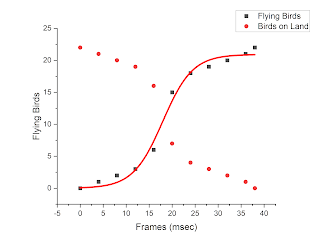
Some birds are foraging in a field. One bird sees something suspicious, it flies up, and, in a moment, all the birds are flying away. It is a memetic transition: nothing physical changes, just the mental state of the birds, which become dominated by the meme that says, "Hey, maybe there is a predator around!"

You can see in the figure the fitting of the number of flying birds as a function of time using a logistic function.


The Covid meme went through a similar phase transition in 2020 that lasted for about two years. Note how at the beginning it followed a curve that looks like a logistic, then it oscillated for a couple of years around a plateau.


But there is no such transition if we search Google Trends for terms related to global warming. On the contrary, we see a steady decline for the "global warming" term and a marginal increase for "climate change." (there is a spike in the data created by Google placing "climate change" in the banner of their search engine. It is a fluke, do not consider it).

It doesn't mean that a memetic transition couldn't happen for climate, but two questions are in order 1) Can it really happen? and 2) If it happens, would it be a good thing? My opinion is that the answer to both these questions is "no," but let me go on with some considerations. 

First of all, what kind of climate event could push people out of complacency and into panic? So far, we have seen plenty of disastrous events, but none has generated a worldwide perception transition. The problem seems to be that there exist strong "memetic antibodies" that prevent people from being affected by the global warming meme. So, forest fires are attributed to arsonists paid by the climate cabal, melting ice is seen as part of normal cycles, heat waves are described as "normal summer weather," rising temperatures to bad measurements or outright scams, and the like. 

The Covid crisis that started in 2020 may have strengthened and nurtured these memetic antibodies, even though they surely existed before. Plenty of people believe in a simple Aristotelian syllogism that goes as:
 
- Covid was a scam
- Covid and Climate Change are the same thing
- Therefore, Climate Change is a scam. 

You may argue that, of these two things, one was a minor threat, whereas the other could potentially destroy human civilization. But the laws of memetics defy rational considerations. Most people cannot reason in terms of data, nor can they understand such things as averages, long-term trends, experimental uncertainties, and the like. They reason according to the Schlesinger principle: it is either complacency or panic triggered by some sudden and spectacular event. 

It is not that a memetic transition cannot happen for climate, but it would require truly exceptional events. Considering that the public completely ignored the 60,000 deaths caused by the 2022 heat wave in Europe, there follows that only something much worse could cause the transition. And nobody sane in their mind would want that. 

But let's imagine that some truly extreme event does basculate the public perception into panic. Would that generate effective action against global warming? Maybe, but from the example of the Covid crisis, we can say that panic doesn't necessarily lead to good solutions to a problem. With Covid, we saw plenty of non-solutions and weak solutions enacted, as well as solutions that worsened the problem. All of them heavily impacting on people's health, dignity, and well-being. 

Worse than that, we saw that once a certain intervention was deemed to be necessary, it was impossible to reverse the decision, no matter what the data and research said. The Covid crisis was managed mainly by politicians, and politicians operate on a binary regime in which they can't change their minds, lest they are accused of flip-flopping. We can only shiver at the idea of what could happen if the climate crisis were managed by the same people, using the same methods. 

Let's hope that no such sudden transition occurs because it could worsen an already difficult situation. But does that mean we have to suffer the destiny of the boiling frog? Not necessarily. Many things can happen and probably will. But I'll discuss that in upcoming posts. 


Sunday, August 6, 2023

We are Losing the Planet. And Nobody Wants to Admit That


The front page of an Italian news site. It says: "High prices push tourists away. Up to 30% fewer people on beaches."

In Italy (and not just in Italy) we had the hottest July ever recorded in history. It was a disaster for the seaside tourism industry. Some sites report 30% less attendance on the beaches, some say it was 40%. Officially, it was because of high prices. It is clearly an excuse: prices do adapt to demand, and we are asked to believe that tourism operators were so dumb to chase away their customers in this way. 

In part, the low attendance to beaches is due to the contraction of the Italian economic system, badly hit by the high prices of energy and commodities. But not just that. I heard friends and acquaintances saying that it was just too hot to stay on the beach. And it makes plenty of sense. I am writing this post from a nice little town in the mountains of Tuscany, where I am spending my summer. July was hot here, too, but nothing comparable to how it was in the towns and on the beaches. This little town is chock-full of tourists. The local fair has seen more people than ever attending; prices are not lower than before, but people are coming anyway.  It has a certain logic: people listen to their sweat glands. And they move to higher grounds if they can. 

The weird thing is that most people nevertheless refuse to admit that there is a climate problem. This hot July is officially a "non-news," and you see that from how careful they are with attributing the loss of attendance on beaches not to the torrid temperatures but to a bad price policy of beach owners. Even at the fair in the town where I am, I casually mentioned climate change during conversations, and the result was, typically, "It is summer, it is normal that it is hot," and, sometimes, "It is a hoax. They are trying to scare us." 

It is weirder than anything I could have imagined, but it is the way it is. And not just in Italy. This July was a special moment that could have placed climate at the center of people's attention worldwide, but it just didn't happen. August may still change the perspective, but I doubt that. People will wait to be boiled alive before admitting that there is a problem with climate. 

At this point, it seems to me that we have to rethink all we have been doing so far about climate change. Maybe it was unavoidable that we were to arrive at this point. Maybe it is unavoidable that we are losing the planet forever, at least for what matters to the human species. But maybe there is still some way to steer things in the right direction. I don't know; I am mulling things over in my head. I'll see to explain what I have in mind in a future post. 

For the time being, here is a photo of where I am now. There are still places with healthy forests around, although nobody can say for how long. 


Sunday, July 30, 2023

Scorched Europe: Can Renewable Energy Save Us?


Figure from Ballester et Al. 2023 showing the average summer temperatures in several Western European States. The situation is rapidly becoming dramatic, and renewables will be desperately needed not just as a replacement for fossil fuels but as a tool for adaptation. 


This July has seen the highest temperatures ever recorded in Europe and worldwide. It is not an exceptional event but part of a trend. Take a look at the graph above; there is no other way to define it than scary. If the trend of the past 10 years is maintained, then the average summer temperature in Europe will keep rising by about 0.14 °C every year. It means one more degree by 2030 and three additional degrees by 2050. And it could be much worse: the authors of the paper interpreted the growth as linear, but these complex systems tend to go exponentially. Maybe the temperature increase could start tapering down, too. But it is safe to assume that the trend will continue and Southern Europe will be especially hit. "Scorched Europe"? Yes. 

Plenty of people find these data surprising. Most have in mind the "1.1 °C" increase normally mentioned when dealing with global warming. But that's a global average of land and sea temperatures, and the sea warms less than the land mainly because it has a larger heat capacity. The summer temperatures on land are another story and are what kills people when they appear in the form of heat waves. Last summer, we had 60,000 excess deaths in Southern Europe correlated to the heat waves. This summer, things seem to be a little better, but how about a future with four extra degrees of warming? And it is not just a question of heat waves: the changes in the ecosystems are going to be profound and irreversible. We may expect drought, desertification, land erosion, and extreme meteorological events. 

The standard wisdom is that we can stop climate change by phasing out the consumption of fossil fuels and hence CO2 emissions. It could be obtained by better efficiency, energy saving, and the diffusion of renewable energy (nuclear energy could also be used, although with many additional problems). It is possible, but could it be done fast enough? Let's see a projection from the recent report to the Club of Rome "Earth for All," a global modeling of the world's economic system. 


You see the energy transition in terms of the phasing out of CO2 emissions. In the "Giant Leap" scenario, the transition is completed by 2050. You can see similar scenarios, although more detailed, in the IPCC reports. Even the most optimistic projections do not see the disappearance of fossil fuel use before 2050-2060.

Now, what would be the effects on global temperatures of phasing out fossil fuels by 2050? The "Earth for All" study models that, too. (the IPCC scenarios provide similar results): 


You see that there is not such a big difference between the two scenarios. Even after that fossil fuel consumption has been brought to zero, in 2050, temperatures keep rising for more than 30 years. It is expected. Reducing or even zeroing emissions does not remove CO2 from the atmosphere; it only stops its concentration from increasing. The system has a certain time lag that keeps it warming even though emissions have become zero. For this reason, most of the IPCC scenarios assume the use of carbon sequestration technologies to be deployed after 2050, even though nobody knows for sure how these technologies could work. Note also that these calculations do not take into account the possibility of "tipping points" that could unbalance the system and cause drastic, rapid, and irreversible changes.  

The point is that if the ratio of European temperatures to global temperatures is maintained at the current values, a global increase of more than 2 degrees corresponds to about 4 degrees more on land in Europe. So, even with optimistic assumptions, it seems that a rapid transition away from fossil fuels can't prevent radical changes in the climate system

Does that mean renewables are useless? Not at all. Renewables, so far, have been considered mainly as a tool for mitigation of global warming. That is, as tools to reduce and eventually eliminate CO2 emissions. But we'll also need renewables as adaptation tools. At this point, it is clear that we need energy in order to survive. 

In the future, Southern Europe may well become an environment comparable to the present one in places such as Dubai, where the average daily summer temperature is about 34 °C. Residents say that there are only three seasons in Dubai: spring, summer, and hell. In summer, people live in air-conditioned homes and move in air-conditioned vehicles to reach air-conditioned spaces for work or for social activities. They drink desalinated water and consume imported food, or food cultivated in irrigated areas. It is perfectly possible to cultivate the Arabian desert, provided that the land can be irrigated, and that requires energy.

Can Southern Europe adopt similar strategies? Yes, but that needs energy. Dubai has an ample supply of low-cost fossil fuels from the neighboring countries, sufficient to create the artificial environments that keep people alive during the summer. They are moving toward renewables, but they are starting from very low levels. In Europe, instead, the fossil fuel supply is limited and expensive, but renewables are already covering a large fraction of consumption (more than 20%). This supply can be gradually increased to support adaptation. We need air-conditioned spaces for people in summer, we need to manage the land to avoid erosion and desertification, to reforest degraded areas, to create water reservoirs, and more. We may need to use renewable-powered precision fermentation to provide food independently of agriculture. 

The renewable-based mitigation scenario is a likely path that the warming-stricken regions may gradually follow, perhaps unwillingly but forced to by the circumstances. People will desperately want air-conditioning even though they keep screaming that global warming does not exist or that "climate always changes." Of course, there are various forms that this strategy may take, and it may be accompanied by massive migration toward Northern Countries and by attempts to drastically draw down CO2 from the atmosphere. Both would require huge amounts of energy. 

At present, these scenarios are politically taboo in the discussion in Europe. Most people in the region seem to ignore or deny the very existence of global warming or to consider it nothing more than a minor nuisance. That may slow down the efforts to mitigate it or to adapt to it. Eventually, though, change is unavoidable. Obviously, nobody likes the idea of Italy looking like Dubai a few decades from now, but it could be much worse.